A visually and cartographically explicit narrative blog about Tampa's built history and development.
(Above banner created from photo in the Burgert Brothers Photographic Collection)


Thursday, June 17, 2010

A Sears surprise

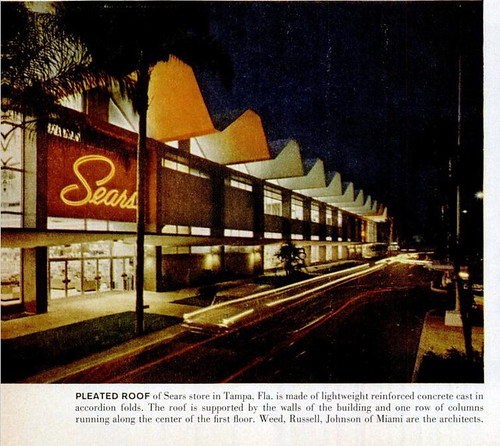
I had always been intrigued by the Erwin Technical School building on Hillsborough Avenue and 22nd street.  I always wondered why someone would build it as a school.  Well, it wasn't built as a school, it was originally built in 1959 as a Sears department store.  During the 50s Sears was looking to grow with modern America.  Americans loved their cars and didn't want the hassle of driving all the way to their downtown and fighting for a parking space to get Juniors new pants for the school.  Thus, the big department stores decided to push out into the wilderness of the suburbs where they could build on large lots to accomodate lots of parking.  Sears realized that Florida was a growing region and decided it would build a lot of new suburban style stores in the area to.  I've counted at least 10 built in Florida between 1950 and 1960.  Sears also knew that the styling of the stores had to be modern and reflect the new architectural style of the region. So Sears hired the law firm of Weed, Russell and Johnson out of Miami.  Principal Robert Law Weed was well known for his Florida modern style, having designed the Florida Tropical showcase house at the 1933 Chicago "Century of Progress" World's Fair and collaborated on the design for the new University of Miami campus.
  

Sunday, June 6, 2010

Modernism in Tampa

By the mid 1920s Mediterranean Revival and Craftsman were  the dominant building styles in Tampa.  Then the bust!  Building slowed all over Florida.  Just as this was happening new building styles were emerging, styles that embraced new building materials, lighter forms and new shapes.  Modernism was a style fashioned for  Florida, it is where styles like Miami Modern and the Sarasota School were championed.  But what and where is Tampa's Modern legacy?  We'll take a peek of what is left and what has disappeared in each corner of the city.  You may be surprised or you may, just like me, enjoy looking at these structures of concrete and glass and varying shapes.

Thursday, May 27, 2010

Punisher House Answers and Questions

It appears that the Old Union Depot Hotel Building (aka Punisher House) was yet another victim of owner neglect and the economy, or owner neglect due to the economy, a Tampa Tribune post indicates.  The article notes that "The hotel's owners, Tampa Union Station LLC, had amassed about $362,000 in code enforcement fines, levied since 2009, at $1,000 a day."  And a recent aerial survey by the city showed that a major roof collapse had taken place.  And as we have seen too often here in Tampa (see Gary School) this eventually leads to total collapse.  After plans for a large condominium project failed to materialize during the downfall the property fell into foreclosure.  So with the consent of the current owners, the city came in on Sunday, May 23rd and demolished the building.  The city will put a lien on the property for $17,000 in demolition costs.


The city has recently set up new incentives to help owners make necessary repairs on historic buildings, in the wake of the Gary School tragedy.  The property that officials and the public are watching most closely is the Kress building on Franklin Street in Downtown Tampa, it is already showing signs of roof stress. But will this mean anything in today's economic climate where many properties sit in foreclosure?

Wednesday, May 26, 2010

Punisher House 0, Tampa Parking 1

Demolition and destruction!  Unfortunately this old building has gone with not a bang, but a whisper.  In fact, it seems that this demolition was barely audible, almost magical.  Well it seems that within the past week or so the Old Union Depot Hotel, at 858 Zack Street, met the wrecking ball. Wikipedia alredy lists the day of death as May 23rd.  This flatiron style, 2 story building was a unique fixture in Tampa.  Built in 1912 to service the recently built Tampa Union Station, it would have been one of the first buidings to greet passengers as they stepped out of the Station doors.  The building had six-sides and almost took on a flatiron style when viewed from the Nebraska.  The building was added to the National Register of Historic Places in 2000.  Of course the building is probably best known for it's role in the Punisher, as the apartment of the lead character and his band of misfit friends.  The lot was to be part of a planned office development dubbed "Union Station" however it is unclear whether the development is still going forward as planned.  The lot is already cleared, leveled and the 717 Parking signs are already up!  Punisher House 0, Tampa Parking 1!

Monday, May 10, 2010

Morgan Street Jail - making way for high speed!

For over the last 100 years there was always a jail on, well not necessarily Morgan, but Jefferson street near the historic Oaklawn Cemetery. In preparation and with the hope that high speed rail would come to Tampa, demolition of the Morgan Street jail started in August of 2009.  This site will soon be the home of Tampa's future High Speed Rail station.  Constructed in 1964, the building was  functional, never anything special.  By the 90s overcrowding was a common problem, and the Orient and Falkenburg jails were used instead. 

However, the 1925 structure it replaced was something.

Monday, April 19, 2010

Burying our Past - Palm River


When the Tampa Bay History journal was re-issued in 2007 (originally published from 1979-1998) the first essay in the edition was an intriguing look at the Tampa bypass canal system and flood management control in central Hillsborough County titled "The Taming of the Hillsborough River: How Tampa Gained a Moat, Destroyed a Creek, and Forgot a River" by Thom Foley.   While the Hillsborough River is mentioned in the title, the essay focused mostly on Palm River and Six Mile Creek.

Palm River is south of SR 60 / Adamo Drive and flows into McKay bay south of Ybor City.  Upstream the river bends towards the north and was called Six Mile Creek.  Here was where Plant's railroad first entered the area.  In the first half of the 20th century if you were traveling into Tampa from Brandon, Plant City, Lakeland or any other community to the East you had to travel down Broadway over an old bridge spanning Six Mile Creek. Surrounding the bridge was the small community of Six Mile Creek that contained a market and service station ready to meet the needs of travelers.  When settlers first came to the area they set up farms along the creek and river.  As the area grew industrial factories began to set up shop near the creek and river shores.

Tuesday, April 13, 2010

Burying our Past - Spanishtown Creek

The first recorded non-native settlement in Tampa was at Spanishtown Creek.  It was said to be inhabited by Cuban fishermen around 1783, many decades before Fort Brooke was established.  Up until the establishment of Henry Plant's railway and hotel in the late 1880s this area was mainly farmland and homesteads.  After Plant's hotel was built tony neighborhoods began to platted directly south of the hotel, centering along Hyde Park Ave. (named after Chicago's Hyde Park neighborhood) and Plant Ave.  Slowly this area started to become more developed.  Below is the original plat map of the Packwoods Subdivision from 1892, from the Hills. Co. Property Appraisers site which shows the path of the creek at that time and how the lots and streets would be laid out: