A visually and cartographically explicit narrative blog about Tampa's built history and development.
(Above banner created from photo in the Burgert Brothers Photographic Collection)


Monday, April 19, 2010

Burying our Past - Palm River


When the Tampa Bay History journal was re-issued in 2007 (originally published from 1979-1998) the first essay in the edition was an intriguing look at the Tampa bypass canal system and flood management control in central Hillsborough County titled "The Taming of the Hillsborough River: How Tampa Gained a Moat, Destroyed a Creek, and Forgot a River" by Thom Foley.   While the Hillsborough River is mentioned in the title, the essay focused mostly on Palm River and Six Mile Creek.

Palm River is south of SR 60 / Adamo Drive and flows into McKay bay south of Ybor City.  Upstream the river bends towards the north and was called Six Mile Creek.  Here was where Plant's railroad first entered the area.  In the first half of the 20th century if you were traveling into Tampa from Brandon, Plant City, Lakeland or any other community to the East you had to travel down Broadway over an old bridge spanning Six Mile Creek. Surrounding the bridge was the small community of Six Mile Creek that contained a market and service station ready to meet the needs of travelers.  When settlers first came to the area they set up farms along the creek and river.  As the area grew industrial factories began to set up shop near the creek and river shores.

Tuesday, April 13, 2010

Burying our Past - Spanishtown Creek

The first recorded non-native settlement in Tampa was at Spanishtown Creek.  It was said to be inhabited by Cuban fishermen around 1783, many decades before Fort Brooke was established.  Up until the establishment of Henry Plant's railway and hotel in the late 1880s this area was mainly farmland and homesteads.  After Plant's hotel was built tony neighborhoods began to platted directly south of the hotel, centering along Hyde Park Ave. (named after Chicago's Hyde Park neighborhood) and Plant Ave.  Slowly this area started to become more developed.  Below is the original plat map of the Packwoods Subdivision from 1892, from the Hills. Co. Property Appraisers site which shows the path of the creek at that time and how the lots and streets would be laid out:


Wednesday, April 7, 2010

South Franklin Street demolition "breaking news"

On South Franklin Street across from the Convention Center there is a row of old buildings that are the last testament of the bustling warehousing and manufacturing center that lined  the waterfront South of downtown.   Recently work commenced on the TECO Streetcar line extension and a few months ago the 2 story building at 238 S. Franklin (The former Fuel teen nightclub) was demolished. You would think that the 2 events were related.  You can see the block below in the birdseye view.   

Then, a friend called me today to say that another building on South Franklin Street across from the convention center was coming down.  Here is the picture I took this afternoon.

Monday, April 5, 2010

Burying our Past - Palma Ceia Springs

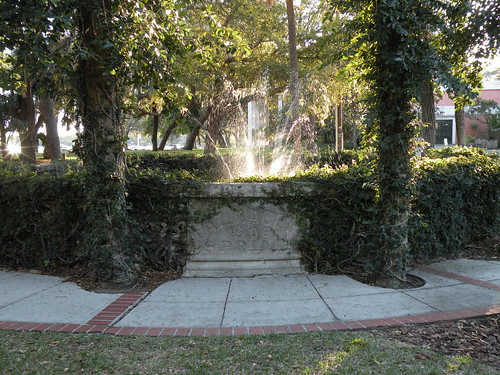
Urban springs are fascinating to me. In Florida, springs usually seem to be billed as "natural destinations" in rural and smaller towns, off the beaten path, or the source for our bottled water needs.  There are a few intact springs within the Tampa City limits.  However, most of these springs have been covered over and made part of a greater underground stormwater drainage system.  One of these is Palma Ceia springs right off Bayshore Blvd. and Rubideaux in Fred Ball Park.

Palma Ceia Spring


In the mid 1800s this spring was known for it's healing powers and people came to bathe in its waters. This fountain was erected in 1906 (as the inscription on both sides indicates) and is supplied by the spring itself. one of the few indications that an actual spring lies somewhere underfoot.  A large pool was erected in 1928 to accomodate the growing population and number of tourists coming to the area.


Monday, March 29, 2010

Burying the Past Series - A creek, a river and a spring.

I will be starting a series of posts entitled "Burying the Past". This will be a brief look at some of the changes that development has brought to the local geography and some of the elements that have essentially been "Buried". Stay tuned!


The River:
The Creek:
The Spring:


Tuesday, March 16, 2010

Gate to Tampania

Browsing through the digitized Burgert Bros. Collection a few years ago I stumbled upon this beauty (I admit it was the lit sign and font that did it). The inspiration for the name of this blog, the entrance gate to the Tampania subdivision. The gate spanned a narrow West Shore Boulevard at North B Street.


As the Florida real estate market boomed in the early 20s companies were scrambling to buy up the wilderness, subdivide it into nice little lots and sell the Florida dream to sunshine seeking Northerners. When companies bought up this land the first thing they would do was clear it and plop down an elaborate entrance and maybe a sales office, usually a large arched gate would mark the entrance. Once these were in place the cold hard selling could begin. In Tampania's instance, the gate also served as the sales, or "field", office. Here you can see the company had it's own sales bus that could bring potential buyers right to the site.

Friday, March 12, 2010

Hiding our past

One would think that the Floridan Hotel and the Tampa Theater building are the last remaining historic high rises left in downtown tampa. Well, that isn't true. There is another 1920s era skyscraper still gracing our skyline.


The large 12 story structure built in 1925 was formally called the Wallace S. Building (The 4 story adjacent structure was home to the Tampa Morning Tribune) and it sits on block bordered by Ashley, Twiggs, Tampa and Zack. Today it is better known as the Huntington Bank building (formally Gold Bank) and my how it has changed.


(The above picture is from Emporis.com)

In the late 60s / early 70s the building underwent a major renovation. Elevator shafts were added on the South side of building, the window court was closed in and she got the royal Florida stucco treatment. All remaining buildings on the block were demolished, making way for the most important feature of late 20th century downtowns, parking! While the renovation hardly does the original justice, it ultimately saved the building during a period when most of downtowns historic structures were being neglected and/or demolished.
There are many more buildings throughout Tampa that have received updates and renovations that hide their historic character, but this is probably the best and most dramatic example.