A visually and cartographically explicit narrative blog about Tampa's built history and development.
(Above banner created from photo in the Burgert Brothers Photographic Collection)


Wednesday, September 22, 2010

Fall comes to Tampania

Fall begins in approximately 6 hours and I couldn't be more ecstatic.  From the second the humidity digs iin ts claws in mid-May the dread sets in, ugh another Tampa Summer!  In many ways it was an excruciatingly long summer, and as I get older they just seem to get longer and harder to bear.  And these last few official hours of summer symbolize the hardest wait of all, the time during which the calendar says fall and yet you are still waiting for that first under 90 breezy and dry day that leads into an even cooler night so you can open your windows and hopefully leave them open for months on end.  Well that usually doesn't happen til October, so still we sit and wait.  

Historically the tourist season has been October through May, and Tampa and the rest of Florida would shrink down to a small permanent population during the unbearable and non-air conditioned summer months.  Board of Trade signs use to boast in big letters "Tampa - Florida's Year Round Destination" while in smaller print the truth comes out "Winter months - October through May", as in the sign below that greeted new comers and visitors at Tampa's Union Station.


Luckily modern Floridians enjoy a more comfortable and climate controlled year round situation.  So, as the weather starts to get more bearable and comfortable, I hope to get out more to take more pictures and find more buildings and interesting features to write new posts on.  In the meantime, the waiting begins.  Here's to a pleasant and fruitful Fall!

Sunday, September 12, 2010

Tampa's "Oldest" House in peril

It seems that historic preservation advocates are on top of things lately.  The story of the threatened status of Tampa's "Oldest" known house has been popping up all over the place lately.  As much as I am an advocate for historic preservation, I wanted to check more into the facts of the story as all causes are subject to sensationalism these days.  Plus I don't always trust the dates of houses shown by the property appraisers office.  The image above is from Google Earth and will be used as a comparison for the house's layout.  Now off to the trusty Tampa Library's Sanborn maps site to do some investigation.  Supposedly, Tampa's current oldest house, at 3210 E Eighth Ave. (shown above), was originally built on the Southeast corner of the City Hall block at Jackson and Florida in 1842.  The current City hall building was built in 1915.

Thursday, August 12, 2010

Sarasota School in Tampa

The Sarasota school of architecture has recently undergone a resurrgence in popularity, prompted by several books and the recent fight and unfortunate demolition of Paul Rudolph's masterpiece, Riverview High School in Sarasota.  Two styles of regional modernism emerged in Florida in the mid-twentieth century, the Sarasota School on the west central coast and Tropical Modernism in South Florida.  There are examples of both schools of work in Tampa, but the Sarasota School is the most prominent of the two here. While most of the members of the Sarasota School came from other areas of the country, Tampa boasted the only native, Mark Hampton.  Mark Hampton worked directly under Paul Rudolph in the Rudolph and Twitchell firm. Hampton then moved back to Tampa where opened his own office and worked in the area until the 1970s, when he moved to Coconut Grove.  Hampton's most famous designs in Tampa were Galloway's furniture gallery, the old St. Mary's Episcopal church, the Horizon House and the Webb residence.

Galloway's Furniture gallery


Saturday, August 7, 2010

Franklin Exchange Buildings - Parasitic Modernism

In the 1960s downtown Tampa experienced a new age of growth.  Up until 1966 the Floridan Hotel remained the tallest building in Tampa.  Office space in downtown was filling up fast and land was being gobbled up by the new interstate and crosstown projects, ultimately creating new barriers for growth within the central business district.  There was nowhere left to go but UP! 

Sunday, July 4, 2010

My fellow Tampanians I wish you all a very happy 4th of July!

Fireworks over the former State Fairgrounds at the Tampa Bay Hotel (Probably not for 4th of July, but festive none the less).

Thursday, June 17, 2010

A Sears surprise

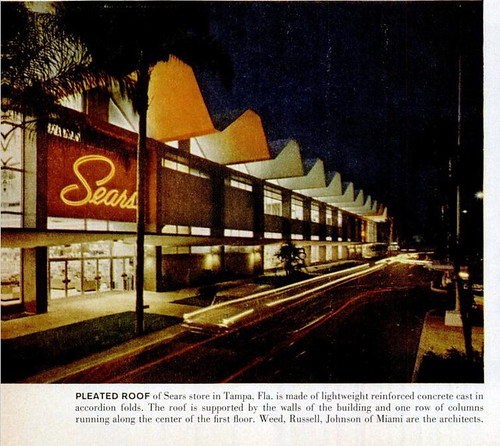
I had always been intrigued by the Erwin Technical School building on Hillsborough Avenue and 22nd street.  I always wondered why someone would build it as a school.  Well, it wasn't built as a school, it was originally built in 1959 as a Sears department store.  During the 50s Sears was looking to grow with modern America.  Americans loved their cars and didn't want the hassle of driving all the way to their downtown and fighting for a parking space to get Juniors new pants for the school.  Thus, the big department stores decided to push out into the wilderness of the suburbs where they could build on large lots to accomodate lots of parking.  Sears realized that Florida was a growing region and decided it would build a lot of new suburban style stores in the area to.  I've counted at least 10 built in Florida between 1950 and 1960.  Sears also knew that the styling of the stores had to be modern and reflect the new architectural style of the region. So Sears hired the law firm of Weed, Russell and Johnson out of Miami.  Principal Robert Law Weed was well known for his Florida modern style, having designed the Florida Tropical showcase house at the 1933 Chicago "Century of Progress" World's Fair and collaborated on the design for the new University of Miami campus.


Sunday, June 6, 2010

Modernism in Tampa

By the mid 1920s Mediterranean Revival and Craftsman were  the dominant building styles in Tampa.  Then the bust!  Building slowed all over Florida.  Just as this was happening new building styles were emerging, styles that embraced new building materials, lighter forms and new shapes.  Modernism was a style fashioned for  Florida, it is where styles like Miami Modern and the Sarasota School were championed.  But what and where is Tampa's Modern legacy?  We'll take a peek of what is left and what has disappeared in each corner of the city.  You may be surprised or you may, just like me, enjoy looking at these structures of concrete and glass and varying shapes.